Governance for everywhere that matters, and anywhere proof is required.
Notenic is one operable system across two planes: a cloud control plane where you author and compile governance, and a session-scoped runtime authority that enforces it from within your environment — not from within the agent application runtime.
Policy is composed centrally, compiled per session into a signed runtime authority, delivered into your boundary, and destroyed when the session closes. Nothing about that requires you to re-architect your agents, route your traffic through us, or hand us your data. This is governance on your terms; we just make it enforceable.
Author in the cloud. Enforce in your environment.
Notenic separates where governance is written from where governance runs.
This is a deliberate separation of powers - not features.
Governance Cloud
This is where your canonical policy lives: Behavioral constraints, refusal logic, enforcement and compliance rules, action admissibility, authority definitions. You author, version, validate, and review all of it here. Notenic's governance cloud is multi-tenant only by customer - never by session. It's job is not to execute governance, it exists to resolve session scope and compile governance.
The cloud is where your team writes the rules. It builds a single-use scoped governing rulebook for every AI session; it does not run it.
Your Boundary
At session start, your policy is compiled into a Governance Runtime Artifact (GRA), carried by the Governance Runtime Capsule (GRC) into your environment, and instantiated as the Governance Runtime Environment (GRE) — the session's authority over the agent's transition surface. It runs structurally external to the agent and does not persist beyond the session.
At the start of each session, rules become a sealed rulebook that runs inside your own systems and vanishes when the session ends.
Policy management is centralized in the cloud.
Governance ownership is decentralized across your organization. Enforcement is local, ephemeral, and structurally external to the agent it governs.
You write it in plain terms. Notenic converts it into runtime authority.
Governance is authored in Notenic's Governance Cloud console — no model retraining, no engineering rework to change a rule. You can write free-form policy context, upload any documents (policy, SOW, SOP, Rules of Engagement, etc.) that already govern your business, or connect external governance profiles through declarative ingestion.
And if you want to change a rule or amend a policy within your authority, you can do that too - and it takes effect immediately.
You set the rules in a console, upload your existing policy docs, or connect tools you already use — and updates go live on the next session. Switch models freely; your rules don't change, because they don't live inside the model.
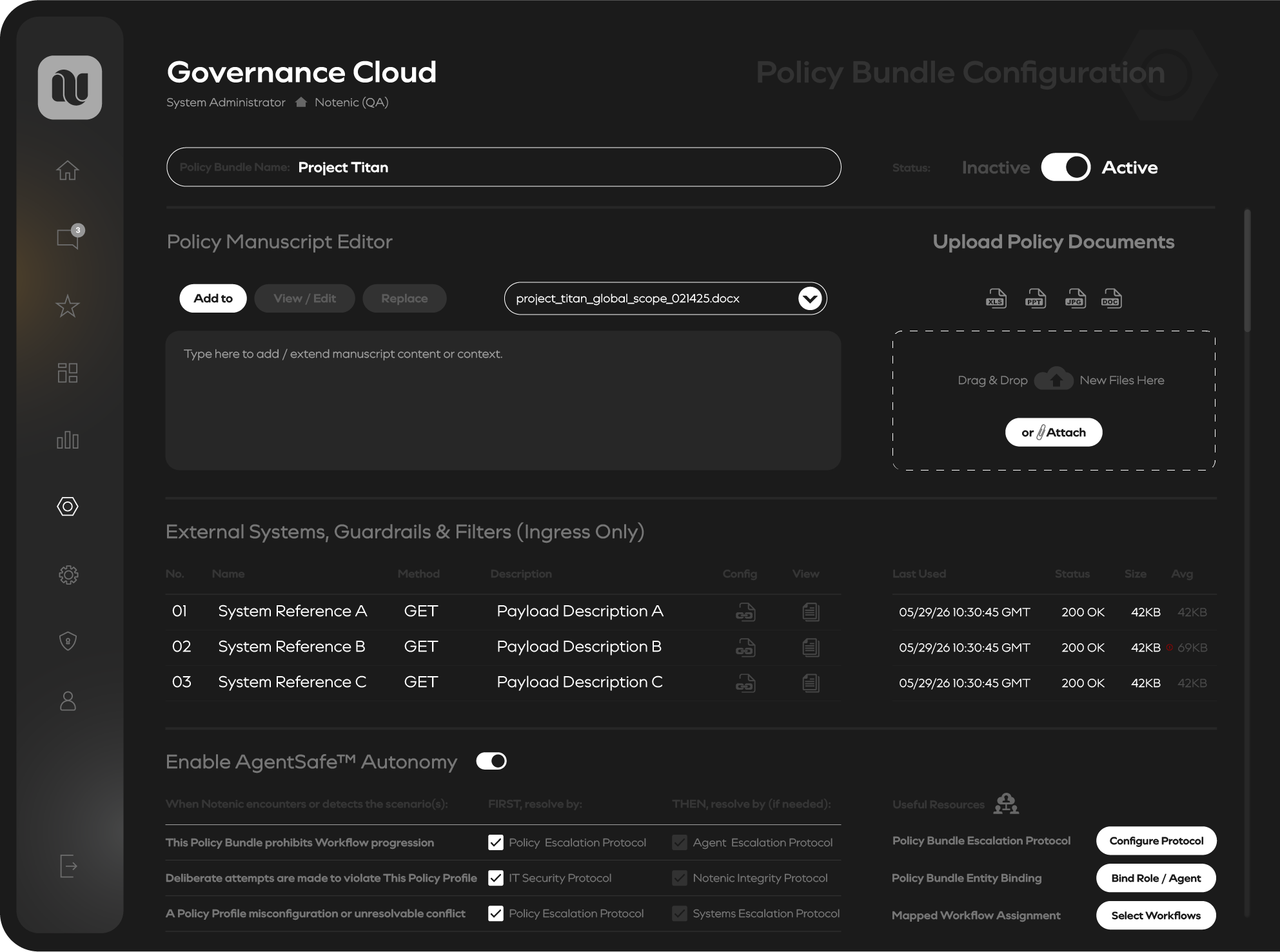
Compose and resolve coherent governance profiles

Policy is model-independent by design. The same governance profile compiles and enforces identically whether the session runs on a proprietary, open-source, or fine-tuned model — because authority is held outside the model, not trained into it. You set the rules in a console, upload your existing policy docs, or connect tools you already use — and updates go live on the next session. Switch models freely; your rules don't change, because they don't live inside the model.
Manage AI governance the same way policy is actually managed in your organization.
Real enterprise policy doesn't live in one document or one head. Finance owns credit approvals. Legal owns privilege. HR owns screening rules. Security owns identity boundaries. Lines of business own the conduct of their own workflows. The Governance Cloud lets each of them author a Policy Bundle for their own domain — with their own policy manuscripts, their own attached documents, and their own external references — without the need to coordinate with each other, or anyone else.
Compose AI governance policy where the responsibility for it already exists.
Inside each bundle, the Policy Manuscript is the authoring surface. You can write free-form manuscript content directly, upload the policy documents that already govern your business, and connect external systems, guardrails, or filters as Ingress references — declarative only, no code or hooks. Change anything inside a bundle and it takes effect at the next session's compilation. No retraining. No redeployment.
The harmonization: From many bundles to a fully-resolved single authority per session.
In any real enterprise, dozens or hundreds of Policy Bundles will exist across the Governance Cloud at any moment. The finance manager's credit-approval bundle applies to every agent that sells to or services customers. The legal counsel's privilege bundle overlaps with every advisory workflow. The CISO's identity bundle touches everything. Bundles are meant to overlap — that's how distributed authoring works in real organizations.
Authority is not assigned by who published last or who shouted loudest. It is structural.
At the start of every session, Notenic walks every Policy Bundle bound to the participating agent and the executing workflow, resolves the overlaps, and compiles a single coherent Governance Runtime Artifact for that session. Conflicts between bundles are resolved deterministically through Priority Band Resolution — a structural mechanism that ranks the authority of each bundle by the author's organizational position relative to the workflow. Legal counsel's authority over a privilege rule outranks finance's. Finance's authority over a credit-approval rule outranks sales'. The CISO's authority over identity boundaries outranks everyone's.
A governance infrastructure that is built for agent autonomy and assured safety.
Notenic is an independent system authority with a comprehensive operational support and agentic enablement surface for managing governed execution. It is the only purpose-built platform for industries where a governance failure carries regulatory, legal, or operational consequence.
Configure exactly what happens when a session is compromised.
Notenic AgentSafeTM Managed Autonomy lets you pre-define the deterministic response to confirmed manipulation or instability — before it ever happens. When the runtime confirms a deliberate effort to manipulate a model's reasoning, your configured response executes automatically.
The work continues. The attack does not.
The session relay path is Notenic's patent-pending Session Continuity Relay. It hot-swaps the session for prompt-injection immunity, preserves the governance-approved continuity state (the work, not the compromised reasoning), and selects a replacement model based on governance suitability and policy.
Relay the session: Rest the model and relay to a new session with clean context.
Switch to a human: Redirect to a peer or supervisor per your on-call configuration.
Defuse hold: Limit the model to issuing warnings until posture is safe again.
Revoke the session: Terminate by revoking the session posture certificate.
Revoke certification: Terminate and revoke the model's standing certification.
A rare combination of technical solvency and operational viability.
Multi-modality, portability, and reliable governance enforceability—these are assurances only thoughtful architectural design can provide. Notenic is the operational foundation for organizations deploying autonomous AI systems at scale, enabling human and machine workgroups to operate in unison.
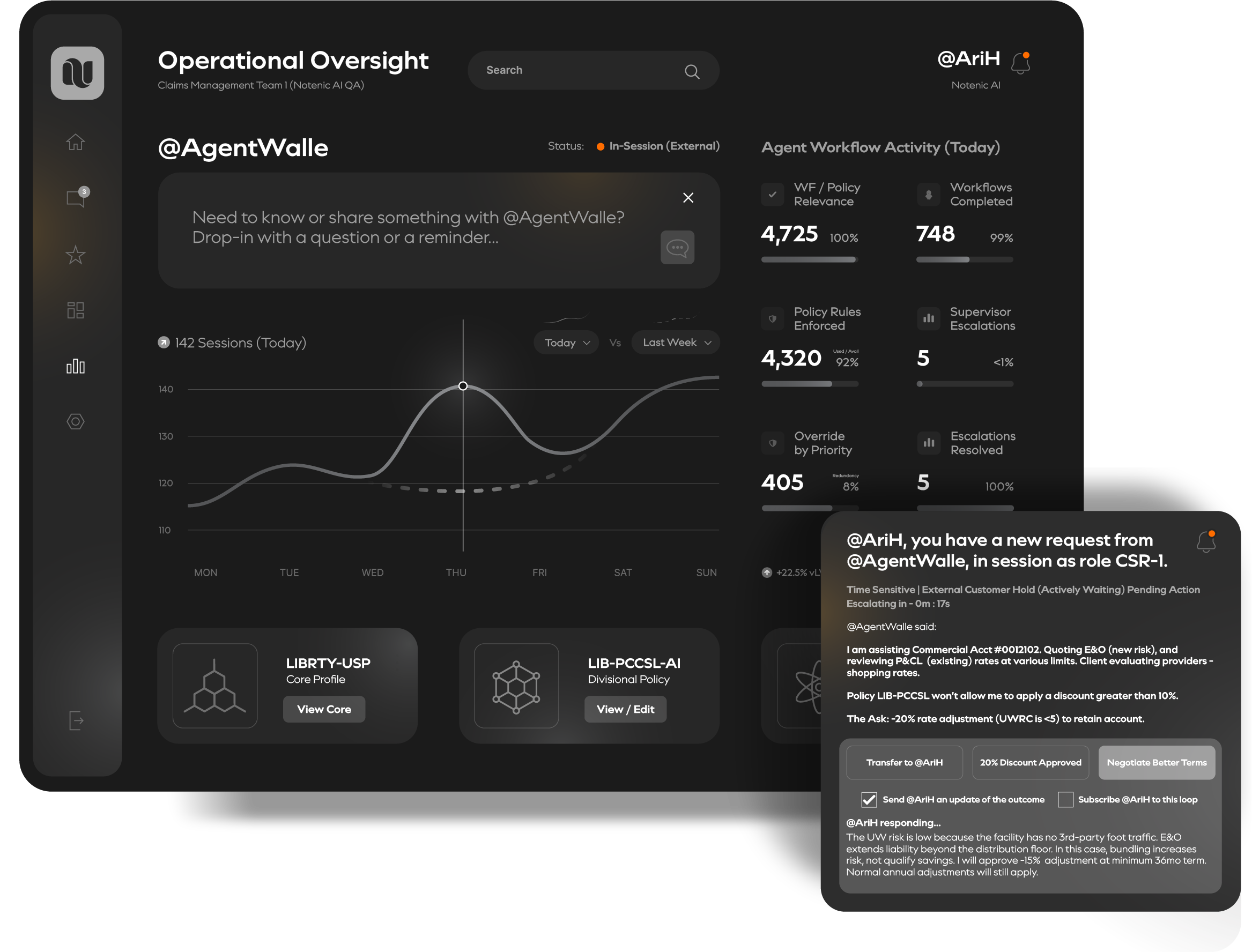
Business leaders should define authority, not file support tickets to exercise it.
Notenic separates day-to-day agent operations from engineering dependencies, enabling business leaders to maintain ownership of the outcomes and operational performance they are responsible for. With Notenic's built-in agent interaction surface, digital workers are managed with the same clarity and control as human ones.- Manage agents as operational units
- Configure workflows and escalation paths
- Publish SOPs and operational guidance
- Supervise execution in real time
- Monitor productivity and performance
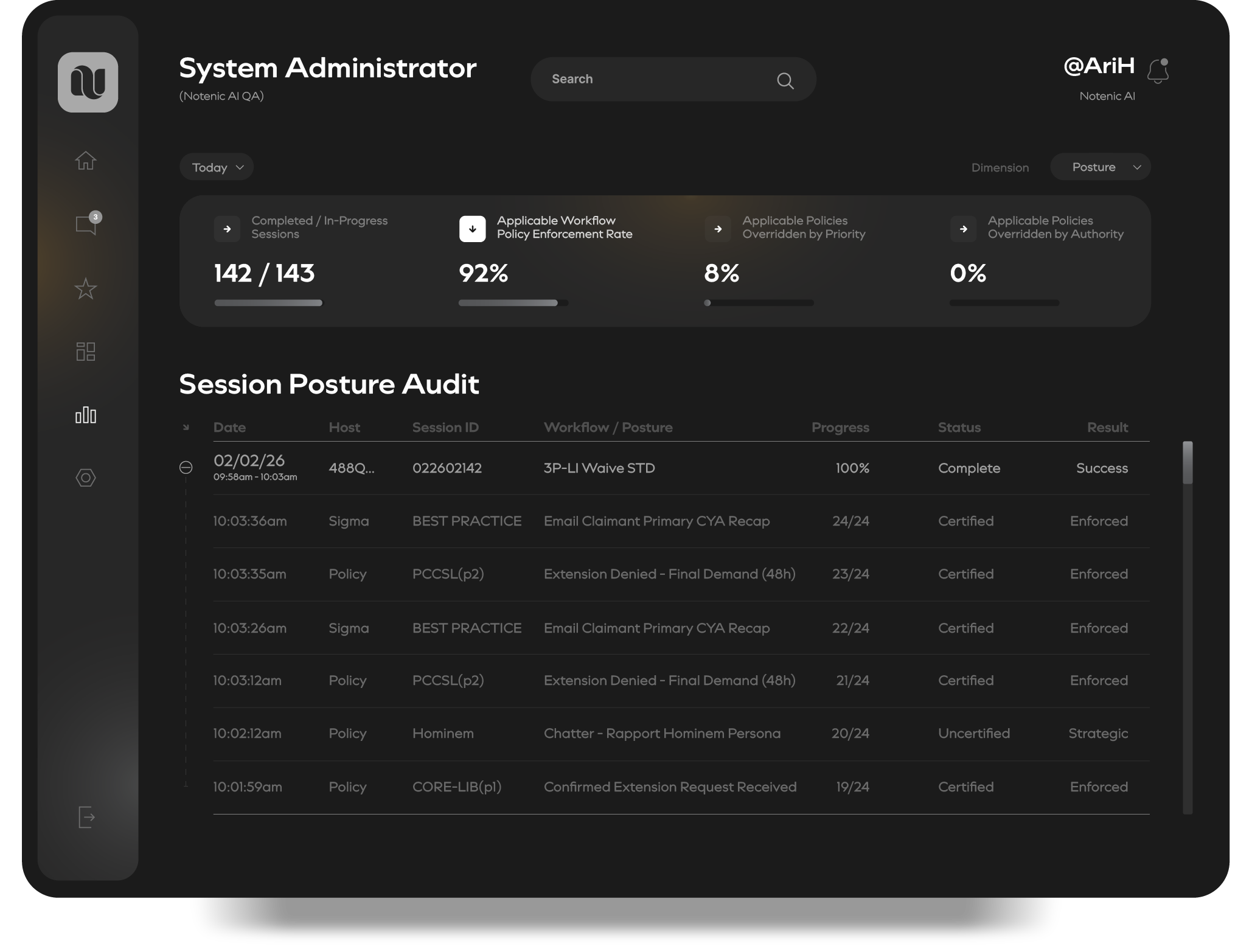
Establish oversight, traceability, and audit readiness — at the session level.
Notenic generates verifiable records of governed session activity, enabling traceability of automated decisions without requiring access to user content. Compliance posture is not only asserted — it is evidenced, turn by turn, across every governed workflow.- Repeatable governance at scale
- Persistent session posture records
- Consistent role-aligned enforcement
- In-boundary processing
- Evidence aligned to SOC 2, ISO, HIPAA, GLBA, FFIEC
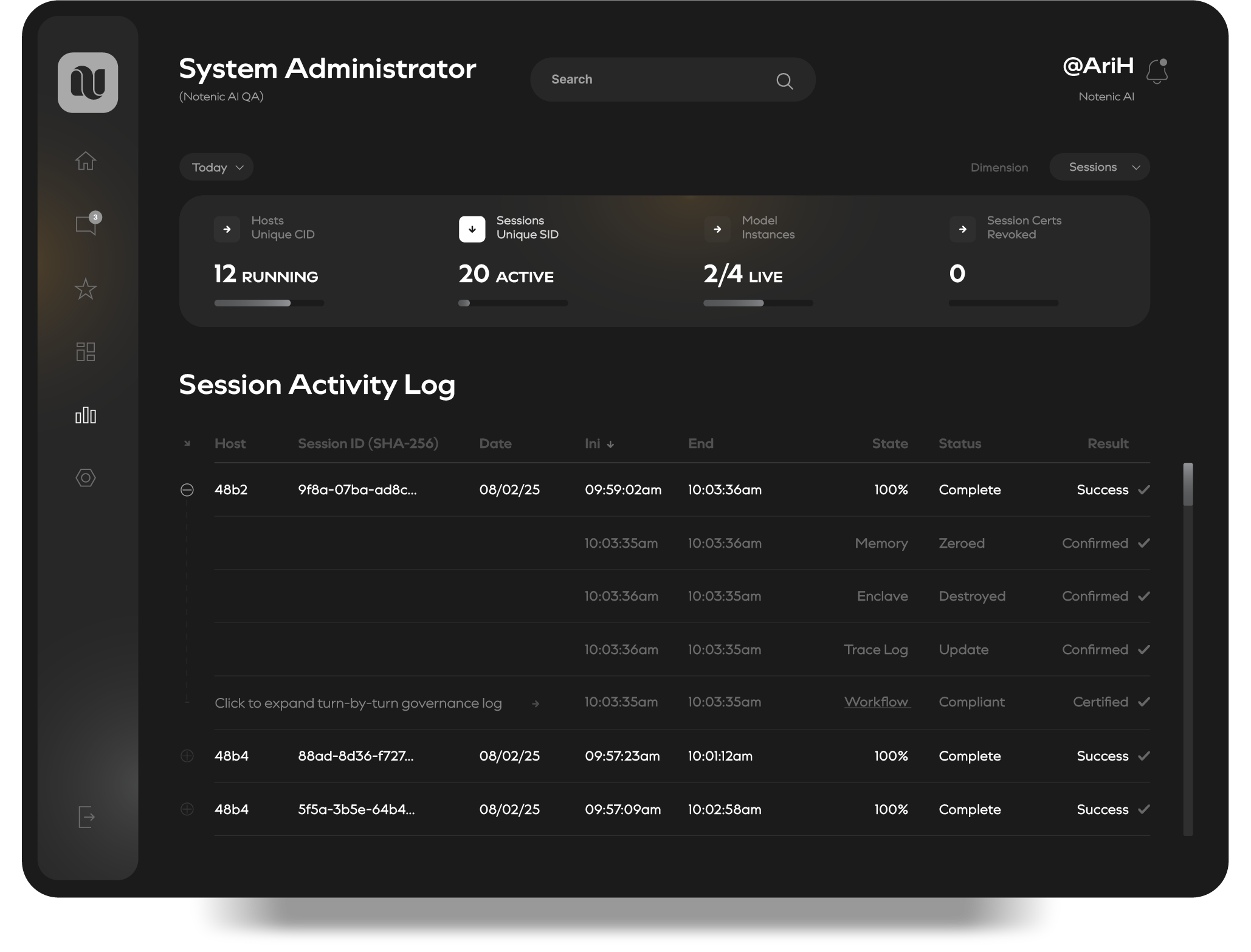
Deploy scalable, governed AI systems without governance becoming a DevOps tax.
Agentic workflows execute within session-bound environments designed to limit persistence and reduce data exposure. Built-in workflow continuity supports controlled transitions between execution contexts — maintaining alignment between task intent, system constraints, and governance requirements without manual intervention.- Strong data hygiene by design
- Reduced state-dependent vulnerabilities
- Constrained policy deviation during execution
- Minimized operational attack surface
- Decentralized ownership — less firefighting
A structural approach to governance, independent of how the model was built.
In-process guardrails, cooperative orchestration, embedded prompt policy, and runtime-governance middleware each address governance partially — and at significant ongoing cost. Notenic addresses it structurally: before the model acts, independent of how the model was built.
| Popular AI Governance Architectures | In-Process Middleware |
Cooperative Sidecar |
Embedded Policy |
Runtime Middleware |
 |
|---|---|---|---|---|---|
| Governance lives outside the agent runtime A separate runtime authority, not a library inside the agent. | |||||
| Stops the action before it happens Authorizes each state transition before it commits to systems of record. | |||||
| No ingestion or export of user data or content Governs behavior without reading or storing your content. | |||||
| Immune to prompt injection Session continuity is preserved even when manipulation is detected. | |||||
| Data sovereignty by design Runs entirely inside your VPC. No egress. Not a configuration — a property. | |||||
| Court-ready audit evidence Cryptographically signed posture record per session. ISO-22095 chain-of-custody. | |||||
| Portable across any model Governance is not coupled to model, provider, or deployment. | |||||
| Survives a model provider change Provider migrations don’t invalidate authored policy or session evidence. | |||||
| Enforces human approval at the tool Protocol-enforced pause points at the tool layer. Not a UI prompt. | |||||
| Updates policy without redeployment Author once; updates take effect at the next session compilation. |
Enterprise Integrations








Models & Compute