Enterprise Governance Infrastructure

Beyond Observation. Absolute State-Transition Authority.

The infrastructure is managed by Engineering. The consequence of the execution is owned by the Business. Notenic physically decouples AI capabilities from execution authority, providing a deterministic runtime that secures the enterprise boundary.

No-Code / Low-Code Compose

Decentralized Policy Ownership.

Domain experts define the rules of the business. They must dictate the boundaries of the autonomous systems executing the work.

The Notenic Control Plane shifts operational authority from the engineering sandbox to the business domain. It enables non-IT personnel to author, version, and manage behavioral policies and role constraints. Workload parameters are defined strictly by the leaders accountable for the outcomes, ensuring execution remains bounded by established business logic rather than engineering assumptions.

Policy management is centralized in the cloud. Governance ownership is decentralized across the organization. Enforcement is local, ephemeral, and structurally external to the agent it governs.
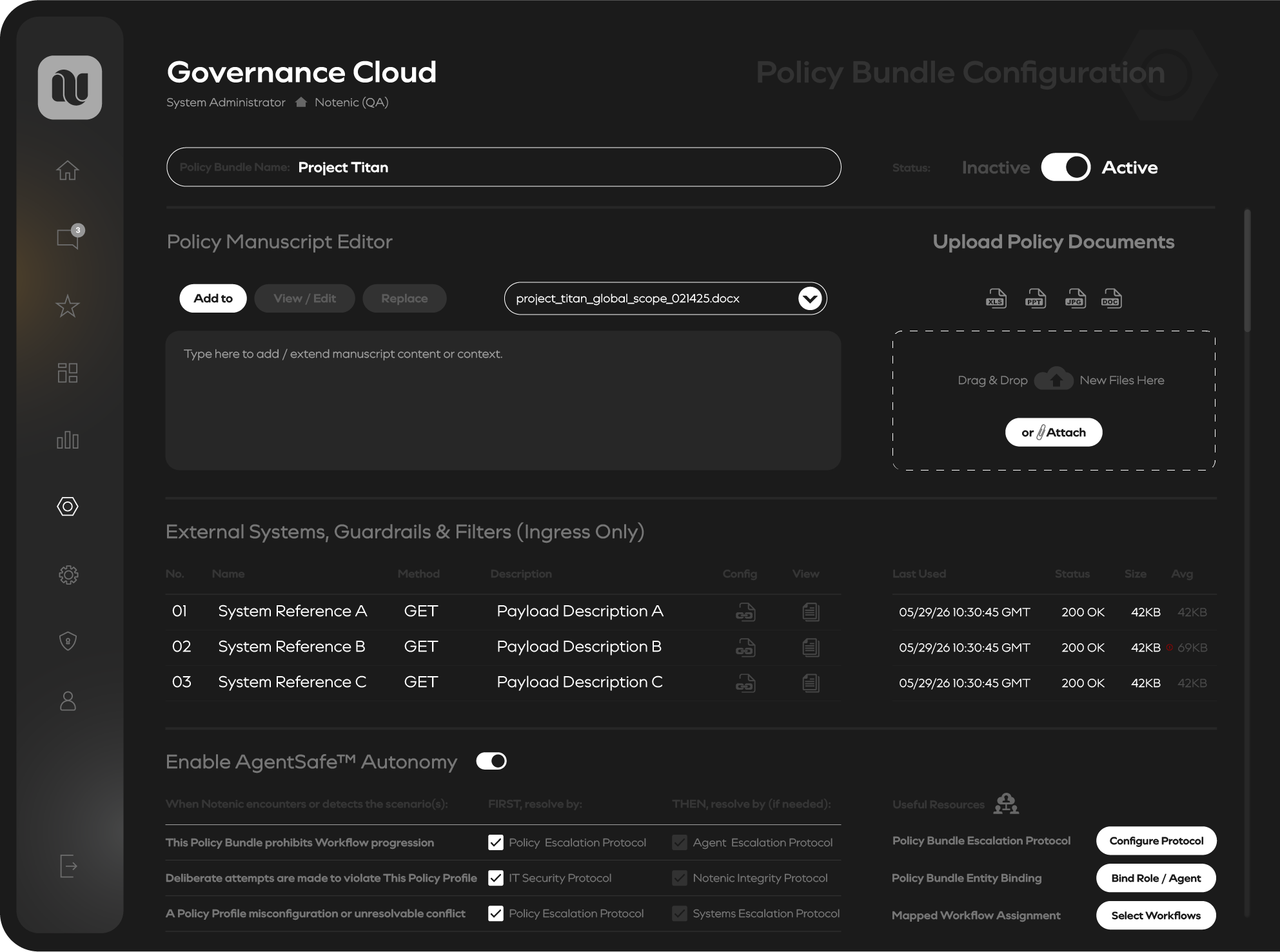
Notenic AI Governance Cloud Console
Contact Surface

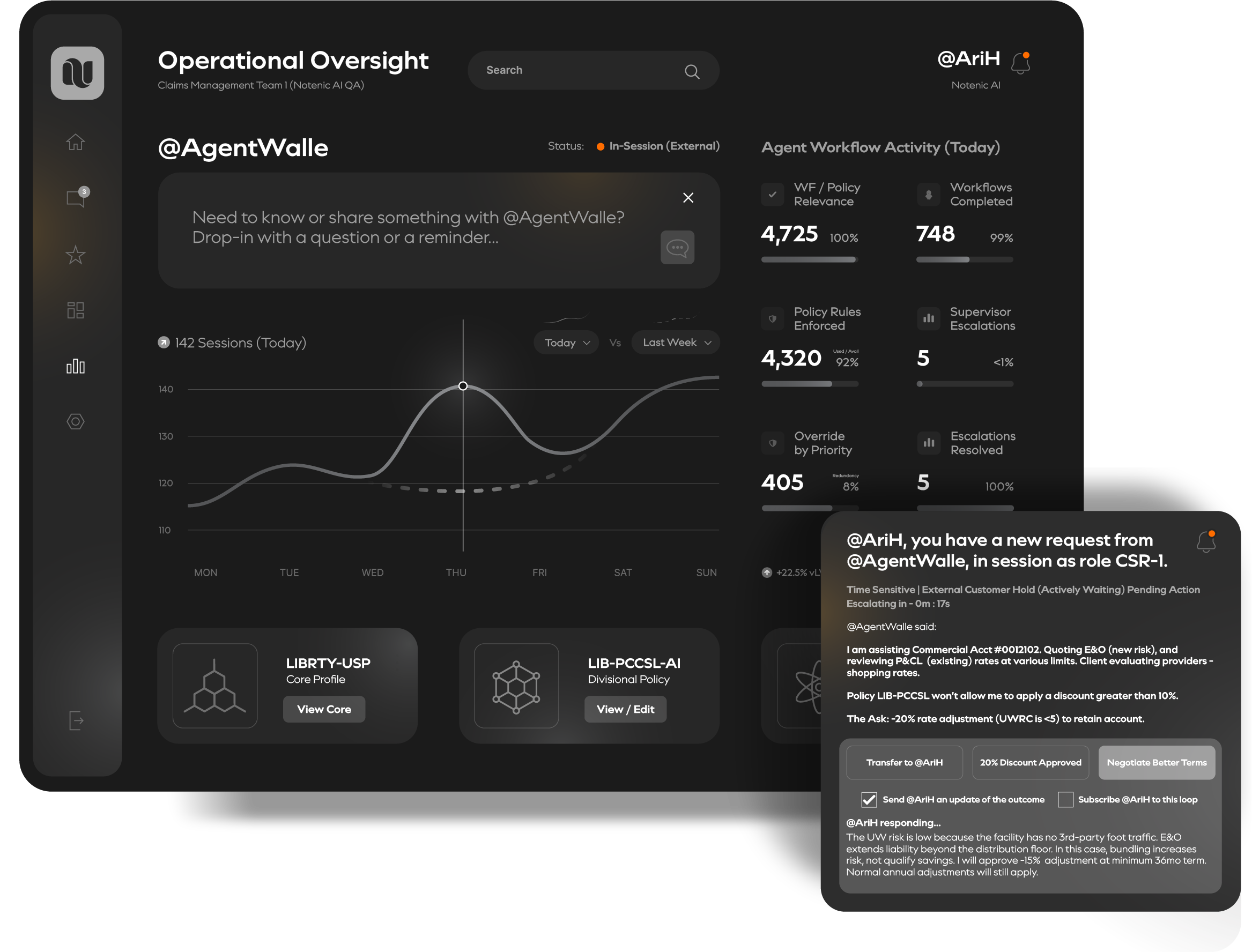
Active Contextual Escalation

When an autonomous system encounters a hard policy boundary, the transaction is paused and routed to the assigned operational authority via a direct contact surface.

Personnel do not merely authorize a handover; they review the session context, inject specific operational logic, modify execution parameters, and dictate the resolution path. The human’s reasoning is cryptographically signed into the permanent audit record alongside the system's actions, and the workflow resumes under explicit, verifiable human authority.

Notenic separates day-to-day governance from engineering workload. Business leaders own the policy, the role authority, and the workflow scope they are responsible for — and Notenic runs that ownership against the AI agents acting under it. The same operational discipline applied to human workforce operations is now structurally enforced upon autonomous systems.

Legal, Risk & Board Oversight

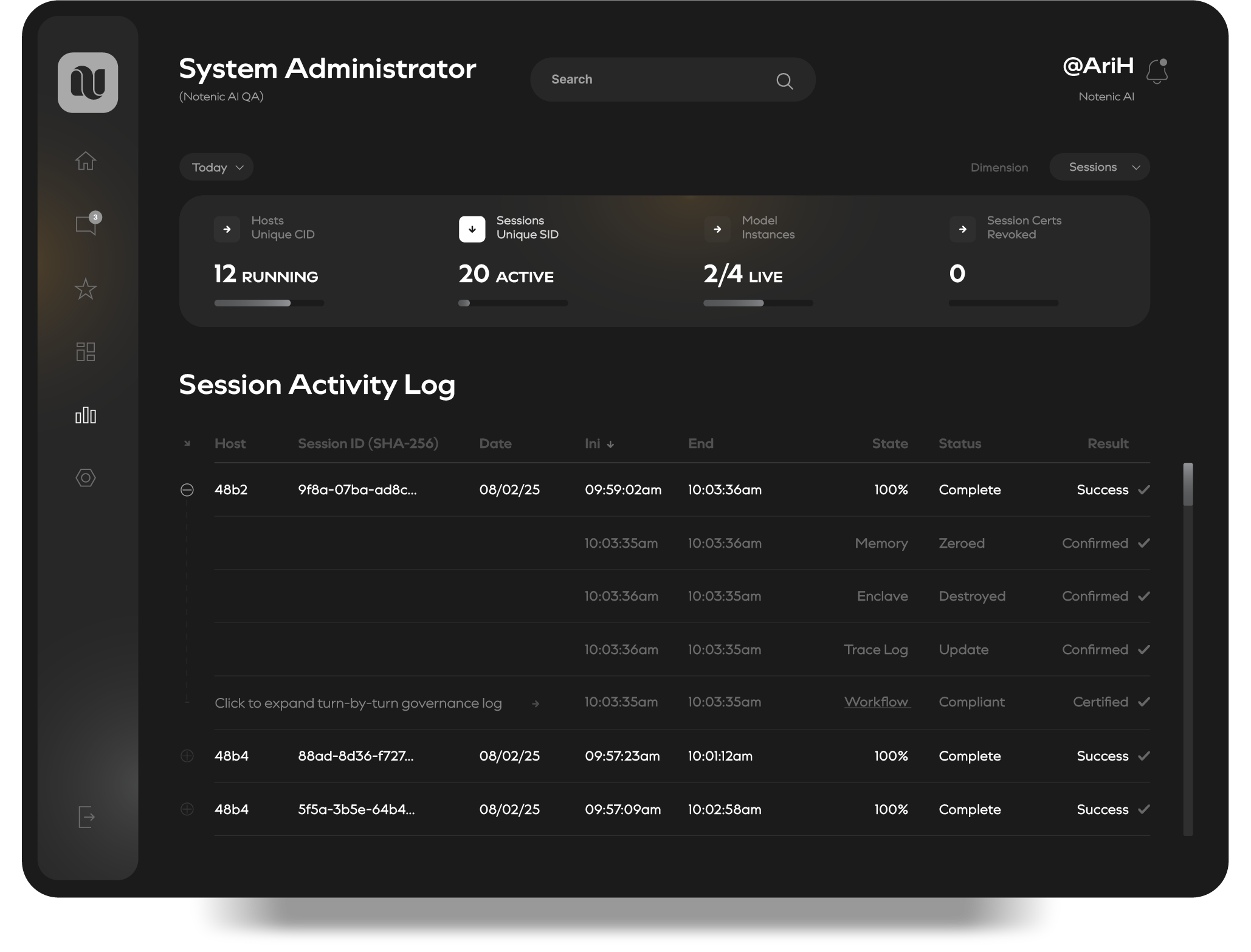
Cryptographic Defensibility

Probabilistic execution is a liability. Deterministic governance is a defense.

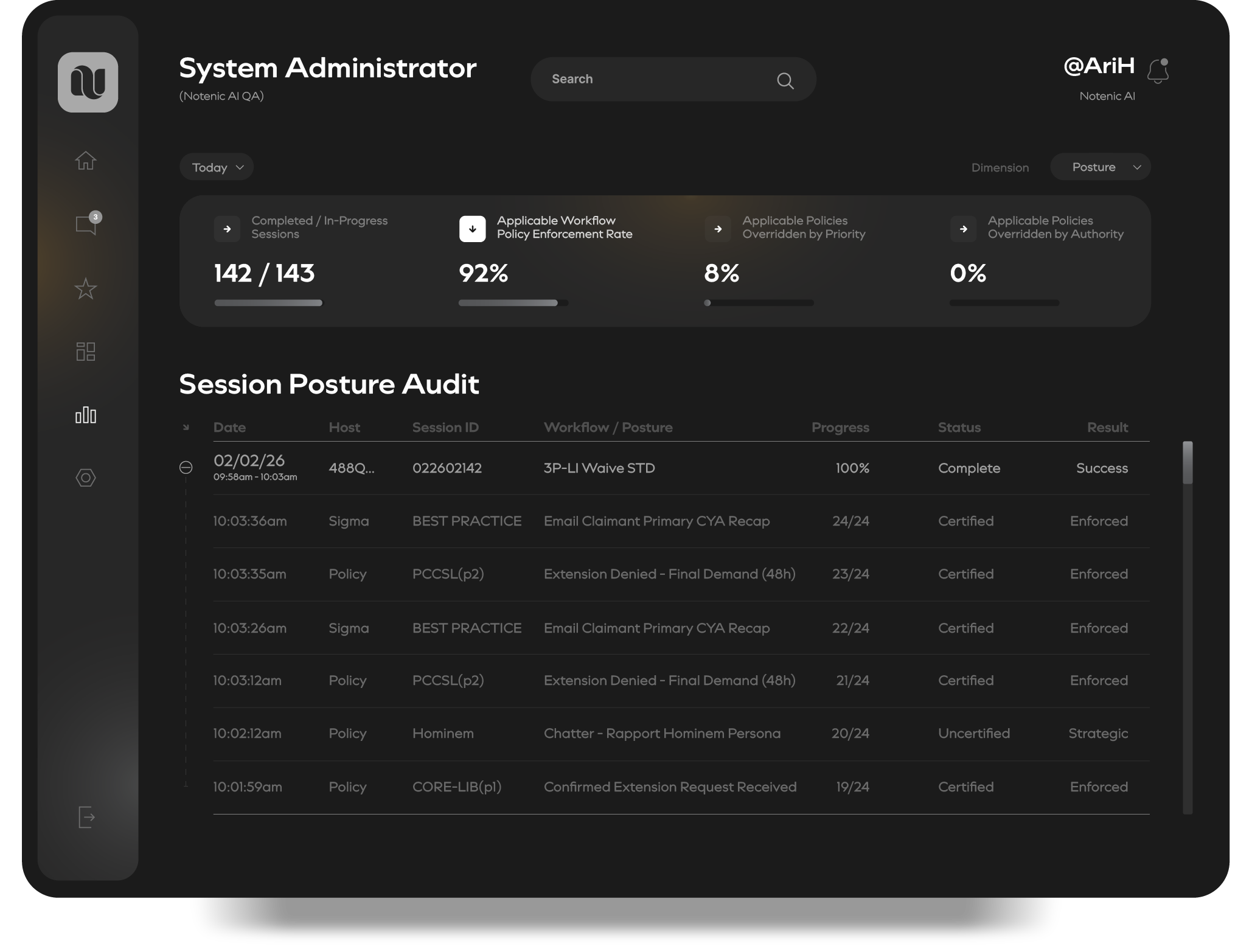
The board requires absolute certainty that autonomous operations comply with regulatory mandates. The Notenic Control Plane provides the immutable evidence required for stringent compliance validation, keeping the infrastructure structurally external to data privacy scopes.

Forensic Posture Auditing: Every session generates a millisecond-level ledger detailing policy enforcement, workflow progress, and authorized overrides, completely eliminating the ambiguity of probabilistic model logs.

Zero-Content Governance: Notenic verifies execution admissibility and role constraints without ever ingesting or exfiltrating session payload content.

Regulatory Certainty: The enterprise retains an unbroken, cryptographically signed chain of custody. This provides undeniable proof to regulators and internal auditors that every autonomous system adhered strictly to sanctioned corporate policy prior to execution.
Decentralized Policy Authorship

Domain experts maintain direct control over autonomous execution parameters, authoring rules where the business responsibility actually lives.

Deterministic Conflict Resolution

Overlapping operational constraints are mechanically harmonized into a single, executable governance graph prior to session provisioning.

Structural Authority Assignment

Agents do not assume implicit permissions. Role authority is explicitly granted, temporally bound, and cryptographically verified.

Absolute State-Transition Authority

Policy conflicts are adjudicated mechanically at the edge, eliminating execution ambiguity and removing the need for post-execution human oversight.

Why Notenic

Structural Separation from Industry Failures

The industry attempts to govern AI by moderating the prompt. We govern the infrastructure by locking the execution path. Legacy middleware and cooperative sidecars rely on the model to police itself—a structural vulnerability that guarantees eventual failure.

Architectural Class Comparison In-Process
Middleware
Cooperative
Sidecar
Embedded
Prompt
Traditional
Runtime Governance
Notenic
Governance lives outside the agent runtime A separate runtime authority, not a library inside the agent.
Prevents unauthorized authority acquisition before execution Authorizes each state transition before it commits to systems of record.
No ingestion or export of user data or content Governs behavior without reading or storing client content.
Immune to prompt injection by architecture Direct and indirect injection are contained at the authority boundary. A manipulated model cannot produce an action outside policy, role, or workflow scope — even when the injection succeeds at the prompt.
Cryptographic sovereignty over key material Runs entirely inside the client VPC. No egress. Not a configuration - an architectural property.
Forensically reproducible audit evidence Cryptographically signed posture record per session. ISO-22095 chain of custody.
Class-agnostic across agent archetypes Governance is not coupled to model, provider, or deployment.
Model-portable across providers Provider migrations don’t invalidate authored policy or session evidence.
Enforces transition-level admissibility at the system of record Protocol-enforced pause points at the tool layer. Not a UI prompt.
Updates policy without redeployment Author once; updates take effect at the next session compilation.
Featured

Enterprise Integrations

.
Natively Supported

Models & Compute

Scroll